
-
Share this page
About the project
This ERC project explores how national systems of labour law can contribute to redefining work beyond productivism, a shift seen as essential for the ecological transition. Instead of abstract proposals, it investigates existing legal mechanisms and social uses of the law that already, at the margins, deviate from the dominant productivist paradigm. By mapping these resources and uses across Europe, the project will develop grounded, legally robust trajectories and proposals for a sustainable, post-productivist future of work.
 In the face of ecological breakdown and growing evidence that the pursuit of economic growth at any cost is a key driver of it, the project "Rethinking Work Beyond Productivism" explores a neglected yet crucial question: What role can labour law play in shaping a future of work that moves beyond productivism?
While most research on the future of work remains theoretical or utopian, this project takes a grounded approach: it starts from existing legal institutions and real-world practices that already, at the margins, deviate from the dominant productivist paradigm, in order to build plausible, actionable pathways for emancipating work from productivism.
Objectives
- Map the legal resources already present in national labour law systems (broadly defined to include individual and collective labour law, social security law and employment policy law) that support non-productivist time-spaces - i.e., places and moments dedicated to activities that have social or ecological value, independently of their economic productivity.
- Investigate how individuals (workers and unemployed people) develop strategic, sometimes even illegal uses of labour law to secure non-productivist time-spaces beyond the law.
- Develop concrete legal arguments and future policy trajectories to expand these time-spaces and support a redefinition of work that, ultimately, breaks away from productivism.
Research Design
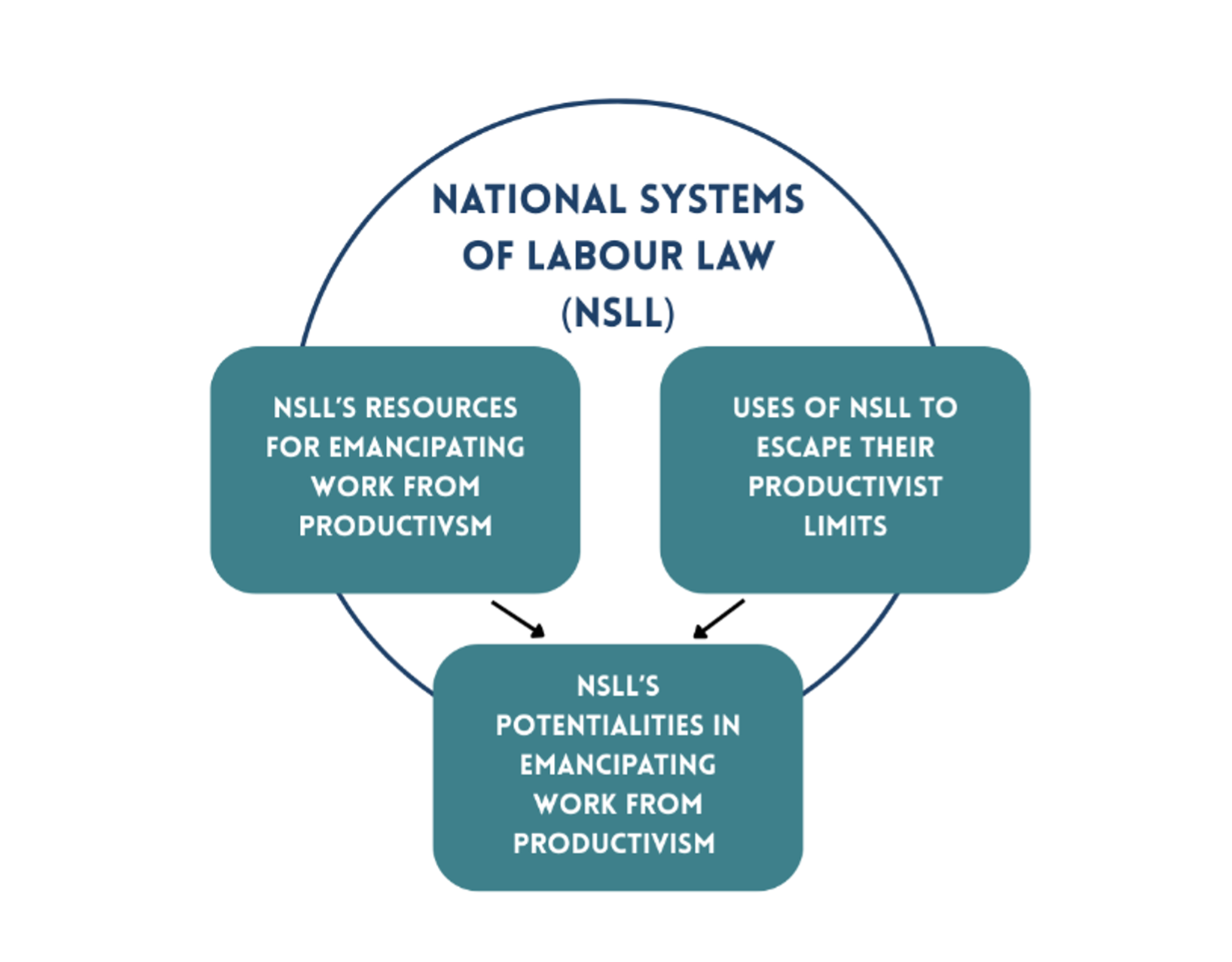 To achieve these objectives, the research design is structured in three key phases:
- First, we will conduct a European comparative survey of existing legal mechanisms that support non-productivist time-spaces (e.g. special leave, working-time reduction, social economy subsidies, etc.).
- Next, our team will investigate, through empirical case studies, how individuals mobilise or bypass labour law to pursue socially or ecologically valuable activities but with no or little economic value.
- Finally, we will construct forward-looking scenarios and design legal strategies for expanding the identified non-productivist time-spaces, based on comparative, international, and European law and validated through participatory foresight with EU stakeholders.
Expected Impact
Scientific: Overcome the current deadlock between critical diagnoses of productivism and the lack of grounded, implementable proposals for change.Societal: Provide policymakers, social partners and civil society actors with concrete legal tools and reform pathways to rethink work beyond productivism.
The project officially started on 1 March 2025 and, over a duration of 5 years, will run until 28 February 2030.
FACTS & FIGURES
- Project title: Rethinking work beyond productivism from labour law and its uses
- Start date: 1 March 2025
- End date: 28 February 2030
- Total budget: 1,498,511 €
- Funded under: European Research Council (ERC)
- More information: https://cordis.europa.eu/project/id/101164934
Updated on December 19, 2025